The word "Algorithm" sounds like high-level mathematics, something only geniuses understand. But actually, every time you brush your teeth in the morning, tie your shoelaces, or pack your schoolbag, you are executing an algorithm!
Simply put, an algorithm is just "detailed steps to do a job well."
Computers are actually quite dumb; they can't think for themselves. To get a computer to find information for us or calculate Pi, we must give it an "Error-Proof Instruction Manual." This manual is what we call an Algorithm.
Let's use a game to help children discover that they are already Algorithm Masters.
Phase 1: Experience "Computers are Dumb" (The Blind Robot)
Goal: Children usually assume, "I say it once, and you should get it." But computers don't work like that. We need to let them experience what "Precise Instructions" really mean.
1. Game Setup:
- Role Play: The parent plays the "Blind Robot" (blindfolded), and the child plays the "Programmer."
- Mission: Command the robot to walk from the door and sit on a chair.
Execution & "Debugging":
- Child: "Go forward!"
- Parent (Robot): Intentionally keeps walking until hitting a wall (because the instruction didn't say stop).
- Child: "Stop! Turn!"
- Parent: Spins in circles on the spot (because they didn't say which way or how many degrees).
- Child (Frustrated): "Ugh! I meant turn toward the chair!"
Constructive Scaffolding:
- Teacher: "The robot can't see the chair. It doesn't know where 'that way' is. You have to give it clearer instructions."
- The Revised Algorithm:Guiding Reflection:
- Walk forward 3 steps.
- Turn right 90 degrees.
- Walk forward 2 steps.
- Sit down.
- Summary: "See? This sequence of 'Forward, Turn, Sit' is a walking algorithm!"
Phase 2: Good Methods vs. Bad Methods (Efficiency Matters)
"Some algorithms are faster... allowing us to solve hard problems." We need children to understand that for the same task, how you arrange the steps makes a huge difference.
1. Task: Packing the Schoolbag (The Bin Packing Problem)
- Scenario: Give the child a pile of items of various sizes (textbooks, pencil case, water bottle) and a small backpack.
2. The Bad Algorithm (Random Stuffing):
- Teacher: "Close your eyes, grab anything, and throw it into the bag until it's full."
- Result: It's a mess, space is wasted, and the water bottle won't fit at the end.
3. The Good Algorithm (Greedy Algorithm / Sorting):
- Teacher: "What if we put the Biggest items in first, then use the Small items to fill the gaps? Let's try that."
- Result: Everything fits, and it's neat.
- Summary: "Although both are 'packing the bag,' your method (Algorithm) was smarter, so you could fit more in. Google does the same thing. It uses smart algorithms to find exactly what you want among billions of webpages in just 0.1 seconds."
Phase 3: The Story of Algorithms (The History)
Once the child has a "feel" for steps, we tell the story.
We use the word "Algorithm" frequently in math and computer science every day, but where does its name actually come from? Let's travel back in the river of history to explore how this concept was built.
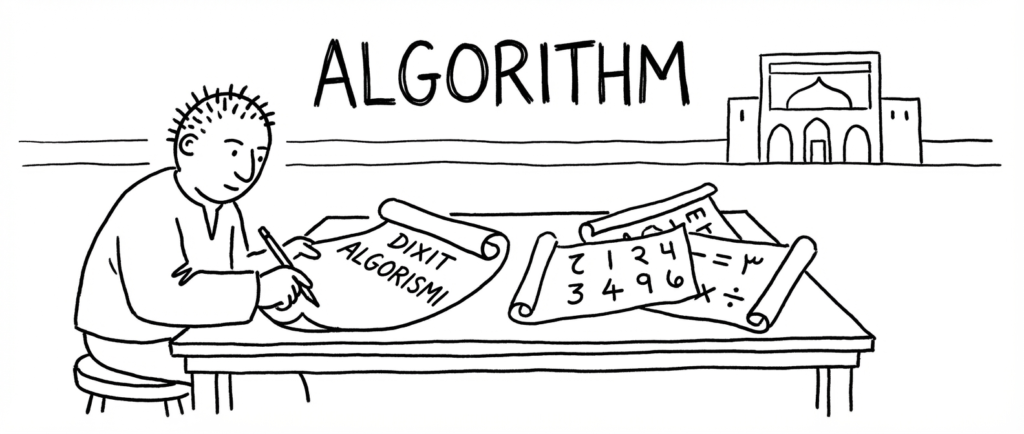
To trace the roots of "Algorithm," we must meet a very important historical figure: Mohammed ibn Musa Al-Khowarizmi. This scholar, whose name means "Mohammed, son of Moses, from Khwarizm," joined the academic center known as the "House of Wisdom" in Baghdad around 800 AD.
So, what did Al-Khowarizmi do to link his name so tightly to modern science?
His work served as a crucial bridge. He successfully transmitted the art of arithmetic, originally from India, to the vast Arab world. We can understand this as him opening a vital road for the spread of knowledge. Subsequently, this precious arithmetic knowledge spread further from the Arab world to Europe.
Knowledge leaves its mark as it is translated and spread. Interestingly, when Al-Khowarizmi's works were translated into Latin in 1120 AD, the very first word of the translation was "Dixit Algorismi" (which means "So said Al-Khowarizmi").
You see, the word "Algorithm" we use today comes directly from that Latinized name—"Algorismi." This reminds us that today's mathematics and computer science are actually built upon a foundation of cross-cultural exchange and accumulated knowledge between India, the Arab world, and Europe over a thousand years ago. Behind every word we learn, there is a rich historical story hidden.