

Binary is the cornerstone of Computer Science, yet to children, it often looks like a boring pile of 0s and 1s. The common "Binary Cards" (dot cards) activity is excellent, but many teachers inadvertently turn it into a math drill.
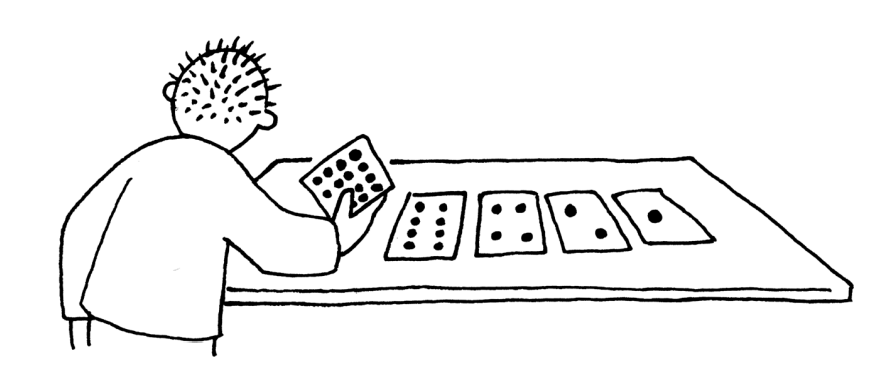
"This card is 1, this is 2, this is 4... okay, now show me 5." While efficient, this method misses the opportunity to cultivate Pattern Recognition and Computational Thinking (Abstraction).
Let’s use "Constructive Questioning" to redesign this activity into a decoding game.
Phase 1: Discovering the Pattern
Goal: Instead of handing out all cards at once, start with just the "1-dot" card, followed by the "2-dot" card.
✅ Constructive Inquiry (Prediction & Observation):
- Display: Show the 1-dot card, then the 2-dot card.
- Ask: "Look at these two cards. How many dots do you think the next card will have?"
- Listen to Ideas:Guiding Reflection:
- Student A: "3 dots!" (Thinking linearly: 1, 2, 3...)
- Student B: "4 dots!" (Thinking exponentially: doubling)
- Reveal & Refine: Reveal the 4-dot card.
- To the student who guessed 3: "Your guess makes total sense—that's how we usually count (1, 2, 3). But look at this card; it has 4. How is the rule for these cards different from normal counting?"
- Predict Again: "Okay, since it goes 1, 2, 4... can you draw what the next card should look like?" (Drawing engages visualization better than just speaking).
Phase 2: Constraint & Construction
The child now has five cards (1, 2, 4, 8, 16).
✅ Constructive Inquiry (Problem-Based Learning):
- The Scenario: "We have a problem. I want to buy a candy that costs $6, but I only have these strange coins (cards). I can't get change back, and I can't tear the cards in half. Can you find a way to pay exactly $6?"
- Observe: The child might try flipping the 8, realizing it's too much, or stare blankly at the 1 and 2.
- Scaffold(When stuck):
- "Does this 8-dot card help us make 6? Or is it too big?"
- "If we can't use the biggest one, which ones do we have left?"
- Advanced Challenge:"Can you make 13? Or 20? Is there any number that these cards cannot make?" Note: This is crucial. It guides the child to discover that binary can represent any integer within its range (Completeness).
Phase 3: The Birth of Symbols (From Physical to Abstract)
Goal: This is the critical step: How do we introduce 0 and 1?
✅ Constructive Inquiry (Encoding & Communication):
Scenario: Have the students arrange a number on one side of the room (e.g., making 9 -> 8-On, 4-Off, 2-Off, 1-On). The teacher stands on the other side, facing away.
- The Problem: "I want to record the number you made, but I can't see it. Can you shout out the status of the cards to me in the shortest, simplest way possible?"
- Attempting CommunicationGuiding Reflection:
- Student: "The first one is open, the second is closed, third is closed, fourth is open!"
- Teacher: "Is there a shorter code?"
- Establishing a ProtocolGuiding Reflection:
- Student: "On, Off, Off, On?"
- Teacher: "Even shorter? What if we wrote it down?"
- Guiding to Symbols: Guide them to use symbols (O/X, High/Low, or 1/0).
- Connecting Concepts: "Exactly! You just invented a method—using '1 for yes' and '0 for no.' This is exactly how a computer records numbers without having eyes!"
Teaching Observation Checklist
| Observation Point | Less Effective Reaction | More Effective Scaffolding |
| When a student predicts the wrong next card | "No, this is 4. Look, it's double the previous one." (Direct Correction) | "You think it's 3? Tell me, why do you think it's 3?" (Probing Logic) (After revealing 4) "Hmm, it's different from what we thought. Why did it become 4? How does it relate to the 1 and 2 before it?" |
| When struggling to make a number | "You need an 8 and a 2." (Giving the Answer) | "What total do you have right now? (e.g., 10). Is that more or less than the 13 we need? If we need more, which card should we flip?" |
| Introducing 0 and 1 | "This is the rule. Memorize it." | "If you could only use two symbols to write a diary entry about the state of these cards, which two symbols would you pick?" |
Conclusion
By following this method, we aren't just "teaching" binary; we are guiding children to "invent" the binary system themselves.
When a child goes through the process of Predicting (the pattern) → Problem Solving (the constraints) → Encoding (the symbols), their understanding of the final formula 0 1 0 0 1 = 9 will not be rote memorization. It will be a moment of pure realization: "Aha! So that's how it works."
Try it
二進位儀表板 v1.0
工作階段統計
目標數值
當前總和
位元暫存器 11111 = 31
工作階段已終止
Reference :csunplugged binary-numbers