

As a parent, I no longer want my child to simply go to school to memorize definitions and cram for tests. Instead, I want them to be truly capable of achieving a deep understanding of a particular topic. For this reason, I took a course on Coursera called "Constructivism and Education in Mathematics, Science, and Technology," taught by Professor David E. Brown from the University of Illinois Urbana-Champaign, which called "Constructivism and Mathematics, Science, and Technology Education".
In the traditional teaching model, the teacher's role is to "impart the Way, teach knowledge, and resolve confusion". Most teachers implicitly operate under two assumptions when teaching:
- My focus should be on what I do as a teacher.
- I can get ideas across.
However, throughout my own learning journey, I have rarely experienced moments of truly learning something. No matter how clearly a definition is stated, I couldn't explain what it was to others. Even after receiving a good education, many students fail to learn fundamental concepts in mathematics and science, such as photosynthesis, what causes the seasons, what the Earth looks like, and so on...
There’s the explanation that I construct in my mind as the teacher.And then there’s the explanation that I express In words or pictures or PowerPoints or whatever. And then there's the explanation that the student construes or constructs in their own mind, based on the expressed explanation, which could be very different than the explanation that I intended as the teacher.
Furthermore, the same teaching method is not suitable for every course. Take, for example, the teaching of typing practice versus chemical equation balancing. While both can rapidly lead to effective results through constant practice (being good at typing vs. being good at writing balanced chemical equations), this kind of teaching method does not allow students to gain a deep understanding when learning chemical equation balancing.
Here is two constructivism assumptions:
- my focus should be on my students and their ideas.
- I can't get ideas across, but I can help my students engage and modify their ideas.
I will use three separate articles to delve deeper into constructivism, covering: investigating students' ideas, the constructivist learning environment, and the challenges facing constructivism.
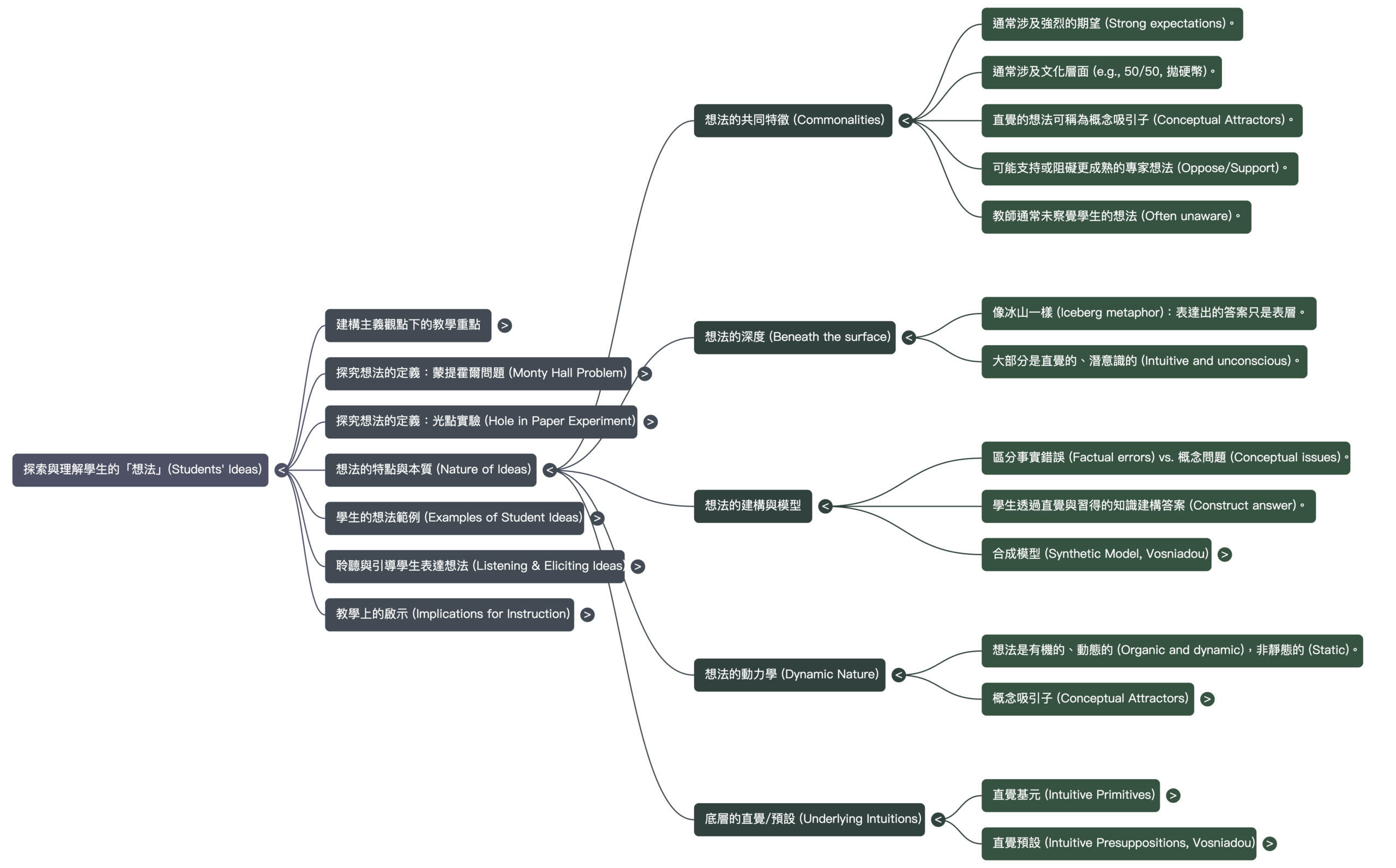
A student’s intuitive ideas are like the powerful ocean currents a leatherback sea turtle has long grown accustomed to—steady, familiar forces that naturally carry it in a certain direction. When we introduce a new scientific idea, it is like the appearance of a new current in the ocean. If we simply tell the student to “follow this new current,” the leatherback will still be pulled back by the stronger, familiar flow it already trusts—even if that current sometimes leads it off course. So the heart of teaching is not to forcefully drag the turtle into a new current. Instead, it is to accompany the learner in noticing which current is carrying them now, and why it feels so natural. Once they become aware of these forces, we can begin exploring together how they might use or gently adjust their existing intuitions, allowing them to move toward a more accurate and coherent conceptual understanding.
The process of implementing a constructivist learning environment is full of challenges, but these difficulties are real and deserve to be addressed. By utilizing research resources, implementing frameworks like "Ambitious Science Teaching," and participating in powerful professional collaborations such as lesson study, teachers and parents can continually develop their capabilities, ultimately helping students effectively express, critique, and revise their ideas in concept-rich domains.