

A student’s intuitive ideas are like the powerful ocean currents a leatherback sea turtle has long grown accustomed to—steady, familiar forces that naturally carry it in a certain direction.
When we introduce a new scientific idea, it is like the appearance of a new current in the ocean. If we simply tell the student to “follow this new current,” the leatherback will still be pulled back by the stronger, familiar flow it already trusts—even if that current sometimes leads it off course.
So the heart of teaching is not to forcefully drag the turtle into a new current. Instead, it is to accompany the learner in noticing which current is carrying them now, and why it feels so natural. Once they become aware of these forces, we can begin exploring together how they might use or gently adjust their existing intuitions, allowing them to move toward a more accurate and coherent conceptual understanding.
I. The Core Shift of Constructivism: Focusing on Student Ideas
The constructivist viewpoint necessitates a profound shift in the focus of instruction. Traditional assumptions often center on the teacher's actions (providing good instruction) and the belief that ideas can be gotten across to students if the teacher is clear. In contrast, the constructivist perspective reframes these assumptions: the focus should be on the student and their ideas. Teachers cannot directly transmit ideas, but they can help students engage and modify their existing ideas. Understanding the nature of these ideas and how they function is therefore central to effective teaching.
II. The Nature and Commonalities of Ideas: Intuition and Strong Expectations
To gain an "inside look" at what an idea is, the sources utilize two core activities that showcase the deep-seated nature of student conceptions:
1. The Monty Hall Problem
This famous game show scenario is used to explore probability and intuition:
- • The Setup: A contestant chooses one of three doors, behind one of which is a sports car, and behind the other two are goats. After the choice is made (e.g., Door #1), the host, Monty Hall (who knows the location of the car), opens a door revealing a goat (e.g., Door #3). The contestant is then asked if they wish to stick with their original choice or switch to the remaining unopened door.
- • The Strong Expectation: Students who have not heard the problem before almost invariably say that it shouldn't matter. When framed in terms of probability, most students insist, "Oh, well, of course it would be 50/50". They view the remaining two options as a simple "flip of the coin".
- The Counter-Intuitive Result: Computer simulations, run thousands or millions of times, demonstrate that it is better to switch approximately two-thirds of the time, while staying only yields about one-third probability of winning. When presented with this empirical data, common reactions include accepting the result but stating, "it doesn't really make sense," or outright suspicion, such as, "There must be something wrong with the computer simulation. It has to be 50/50".
2. The Hole in Paper Experiment
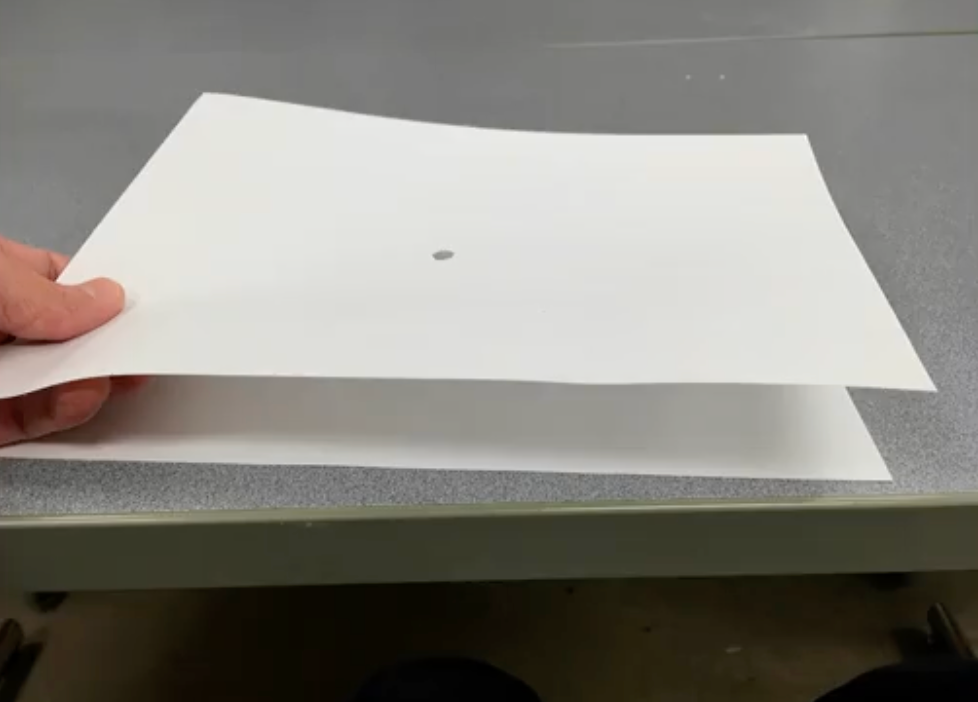
In this activity, students are asked to predict what they would see on a bottom piece of paper if light passes through a small round hole poked in a top piece of paper that is raised up.
- The Strong Expectation: A prediction made by roughly 99% of students is that they would see a single spot on the bottom paper.
- The Observation: The observed result is that there are multiple spots, and the spots are rectangular, despite the hole being round.
3. Commonalities of Ideas:
These activities highlight several fundamental characteristics of ideas:
- Ideas often involve strong expectations. Students often feel the expected result (e.g., 50/50, or a single spot) "goes without saying". They are "very very surprised" when these strong expectations are not met.
- Ideas often involve cultural aspects. For instance, the 50/50 idea may stem from a culture that "thinks about gambling and probability".
- Intuitive ideas can be called conceptual attractors. Our thinking seems to be "attracted to particular ways of making sense of situations".
- Ideas are dynamic and organic. A student (Tanya) who experienced a powerful, surprising empirical result (a bulb lighting in an unusual configuration) spontaneously mentioned the correct result 41 seconds later, but less than two minutes after the initial surprise, she returned to her original, strong intuitive idea (that the tip of the bulb must touch the battery). This shows that the core intuition—acting as a conceptual attractor—can dynamically reorganize the student's expressed idea, overriding direct experience.
III. Students' Deep Ideas: Specific Cases in Science and Mathematics
The answers students express are often just the tip of the iceberg, hiding a whole complex of intuitive sense-making and intuitive presuppositions beneath the surface. These ideas are often surprising to teachers, but are frequently very reasonable to the students who express them.
1. Intuitive Presuppositions in Science:
| Concept Area | Student Idea / Synthetic Model | Underlying Intuitive Presupposition | Consequence |
|---|---|---|---|
| Earth Shape & Gravity | Fishbowl Model: The Earth is a sphere, but people live inside on a flat surface, with a sky dome above. | Observable: Where I live is flat; Presupposition: There is a definite down direction; Taught Idea: The Earth is a ball. | Students create this synthetic model to reconcile taught ideas with their intuitive experiences. |
| Air and Gravity | Air Causes Gravity: If air is removed (a vacuum), things would "just drift off the table" | Observation: Astronauts float in space because space is a vacuum. | This idea is "consequential" and causes difficulties when solving problems involving gravity. |
| Matter and Weight | Tiny things weigh nothing: A very small piece of clay "weighs nothing at all" | Experience: "I can't feel anything, so therefore it doesn't weigh anything". | This idea is found even among middle school students and poses challenges to understanding the theory of matter |
It is crucial to recognize that many scientific explanations (such as living on a sphere that moves and turns around) are extremely counterintuitive compared to daily experience.
2. Student Ideas in Mathematics:
| Concept Area | Student Idea / Bias | Impact |
|---|---|---|
| Fractions | Whole Number Bias: Students incorrectly believe the fraction with the bigger numbers (numerator and denominator) is the biggest fraction. They find multiplication with fractions "very difficult" because multiplication with whole numbers makes bigger, but fraction multiplication does not. | As much as 80% of children in some studies cannot order fractions or perform basic operations like adding them. |
| Equal Sign | Operational View: A majority of students view the equal sign as meaning "and the answer is," like the equal sign on a calculator. | Students holding this view are far less likely to use the more sophisticated algebraic method (such as subtracting 10 from both sides of the equation 4m+10=70) than students who hold a relational view (that both sides are equal in quantity) |
IV. Instructional Implications: Listening and Eliciting Ideas
Given that students' ideas are rooted in deep, intuitive presuppositions, simply "telling" them the correct answer is typically ineffective, particularly for conceptual issues. Teachers must instead help students express, critique, and modify these ideas.
1. The Importance of Listening:
Arnold Erenss, "You have two ears and one mouth. Use them in that proportion". Teachers should adopt a neutral stance toward what the student says, avoiding surprise, and encouraging them to tell me more about their ideas. Listening helps bring intuitive ideas out so they can be examined more consciously.
2. Effective Questioning (Clinical Interviewing):
Clinical interviewing is considered the "gold standard" method for eliciting and exploring students' ideas. The tone and type of questioning are critical:Tone和Question TypesGuiding Reflection:
| Questioning | Less Effective | More Effective |
|---|---|---|
| Tone | Less effective probing questions attempt to lead students away from wrong answers; | The tone should be one of genuinely asking for their ideas, not testing them for the right answer. |
| Question Types | Questions using technical vocabulary (e.g., "photosynthesis") or focusing on factual knowledge (e.g., "How much is the earth tilt?"). These often sound "schoolish" and lead to brief responses. | Ask about observed phenomena and conceptual ideas. |
| Example | What causes the seasons? | try, "Why do you think it's warm in the summer and cold in the winter?" |
| technical | Trying to get students to admit they are wrong (e.g., “Do you really think sunlight—with no weight at all—turns into mass during photosynthesis?”) | Ask students to draw how something works. This is a "very powerful" technique, especially for visual, microscopic, or sub-microscopic processes, providing context for further exploration. |
By asking good conceptual questions and listening without judging, teachers can draw out the intuitive resources students are relying on.