

In Computer Science, "Graph Coloring" is a classic challenge regarding the management of "conflicts." When we want to color a map so that no two adjacent countries share the same color, we are actually dealing with a complex logical reasoning problem.
But for children, this is usually just a coloring game. How do we guide them from intuitive doodling to discovering the "Four Color Theorem" and the engineering mindset of "Constraint Satisfaction"?
Phase 1: Observe Phenomena - Starting with "Trouble"
Scenario Design:
Imagine a cartographer (map maker) who is very poor and cannot afford many paints. If he needs to color a map where adjacent countries cannot be the same color (otherwise the borders won't be clear), what is the minimum number of colors he needs to buy?
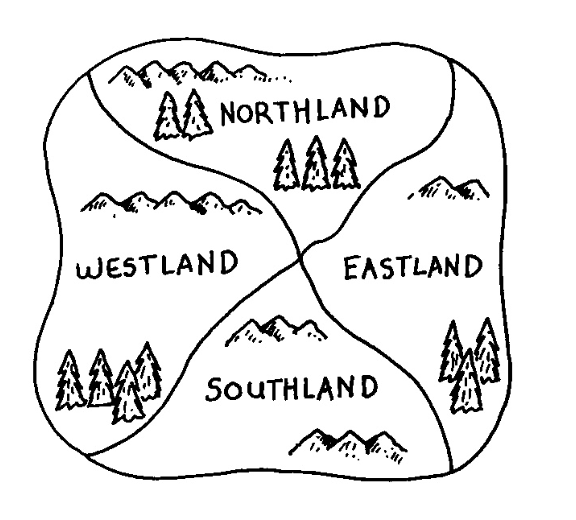
For example: This map shows four countries.
If we paint the North Country Red, then the West Country and East Country cannot be Red because their borders with the North would become hard to distinguish.
We can paint the West Country Green.
At the same time, we can also paint the East Country Green, because the East and West countries do not share a border. (If two countries only touch at a single point, that doesn't count as sharing a border, so they can be the same color.)
The South Country can then be painted Red.
Result: We only needed two colors to complete this map.
In our story, the mapmaker is very broke. So ideally, we want to use as few colors as possible.
Observation Point:
Give the child a complex map. Observe whether they casually grab markers and start drawing, or if they stop to think first. At this stage, the teacher/parent should adopt a neutral stance and not show surprise at the child's attempts.
Phase 2: The Script (Transforming Inquiries)
When the child starts coloring, do not rush to correct errors. Instead, explore their thinking process.
| Questioning | ❌ Less Effective (Correcting/Testing) | ✅ More Effective (Clinical Interview/Inquiry) |
| Tone | "You used the wrong color; these two are connected, so they can't be the same." | "If you were standing on the border of these two countries, would these colors let you clearly tell which side is which?" |
| Question Types | "What is the 'minimum number of colors' for this map?" | "How did you decide to paint this spot red? Is it possible for it to be another color?" |
| technical | "Did you know? Any map only needs 4 colors." | "If you change this color, what happens to the countries next to it? Let's see if there is any spot that is a 'Has-to-be' color?" |
Phase 3: Hands-on & Visualization (Visualize)
Discovering "Inevitable Rules" To make thinking more flexible, we use movable markers (like colored poker chips, LEGO bricks, or tokens) instead of coloring directly with pens.
- Guidance: "Instead of coloring it in immediately, can you use these chips to show me your idea? This way, if we find out it doesn't work, we can change our strategy anytime."
- Discovering the Core: When the child attempts to swap chips, guide them to say it themselves:"Because this piece is Red, the neighbors 'must not' be Red."
In Computer Science, this is known as a "Has-to-be" rule (Constraint). Letting the child summarize this rule on their own is a triumphant moment in constructivist teaching.
Phase 4: Guiding Conflict & Challenge
Students usually intuitively believe that "the more complex the map, the more colors are needed." We do not correct this; instead, we let them challenge the limit.
- Challenge Mission: "Try it. Can you draw a map that absolutely requires 5 colors?"
- Listening & Observing: The child will go through a process of trial and error. When they say, "This map is so huge, it definitely needs many colors," remain neutral : "That sounds reasonable. So, do you think if we add more countries, the number of colors will increase?"
- Cognitive Conflict: When the child discovers that no matter how they draw it, 4 colors always seem to be enough, their understanding of the "Four Color Theorem" will be far more profound than simply memorizing a definition.
Phase 5: Concept Connection
From Maps to Schedules Finally, transfer the concept of "coloring" to a more abstract level of problem-solving.
- Question Example: "If we don't look at this as a map, but as a School Schedule. If two subjects have the same student enrolled (just like two countries sharing a border), can they be scheduled at the same time (painted the same color)?"
- Deepening Understanding: Through this dialogue, the child understands that this isn't just drawing; it is logical reasoning for handling "Conflicts" and "Scheduling."
Teaching Observation Guide (Clinical Interview Guide)
This table helps you master interview techniques during the activity:
| Observation Point | ❌ Less Effective Response (Transmitter) | ✅ More Effective Guidance (Collaborator) |
| When the child says "It's hard" | "It's not hard, just look at the neighbor's color." | "Oh? Which part is making you feel stuck? Can you draw/show me where your trouble is?" |
| When the child asks "Is this right?" | "It's not hard, just look at the neighbor's color." | "What do you think? Let's check together. If you were the King of these two countries, would you feel the border is clear?" |
| Discussing the Four Color Theorem | "Yes, there is no color conflict in this area." | "Do you think 4 colors of paint are enough? If we make this line a bit longer, will we run out of colors? Try and see!" |
💡 Teaching Advice:
In this activity, the teacher is not a machine dispensing algorithms, but a "Developer of Thought" (like the developer fluid in photography that reveals the image).
Through clinical interviews, we allow the child's "submerged" intuition to surface. We let them construct a deep instinct for "Constraint Satisfaction" and "Optimization" through trial and error.
Reference :csunplugged graph colouring